
Mitsubishi Outlander: Engine Cooling
General Information
The cooling system is designed to keep every part of the engine at appropriate temperature in whatever condition the engine may be operated. The cooling method is of the water-cooled, pressure forced circulation type in which the water pump pressurizes coolant and circulates it throughout the engine. If the coolant temperature exceeds the prescribed temperature, the thermostat opens to circulate the coolant through the radiator as well so that the heat absorbed by the coolant may be radiated into the air.
The water pump is of the centrifugal impeller type and is driven by the drive belt from the crankshaft <2.4L ENGINE>. The water pump is of the centrifugal impeller type and is driven by the timing belt from the crankshaft <3.0L ENGINE>. The radiator is the corrugated fin, cross flow type.
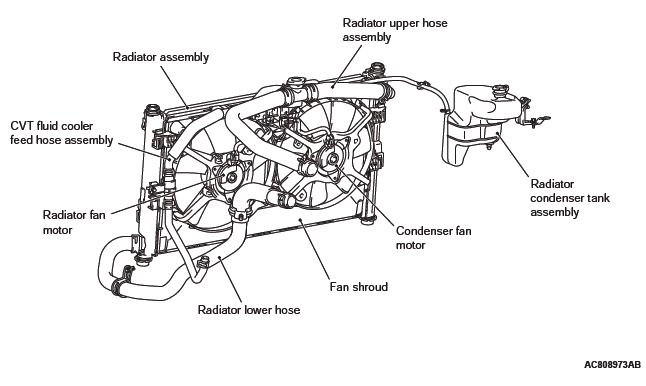
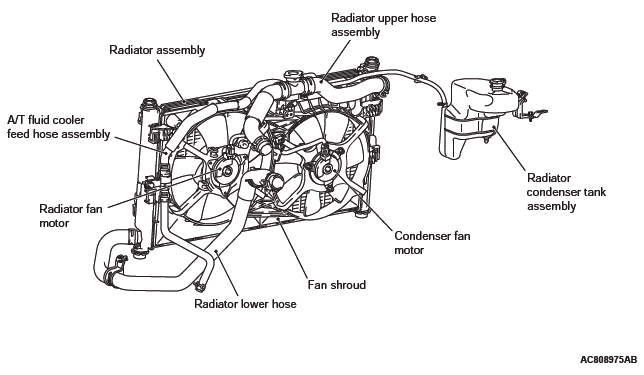
CONSTRUCTION DIAGRAM
<2.4L ENGINE>
<3.0L ENGINE>
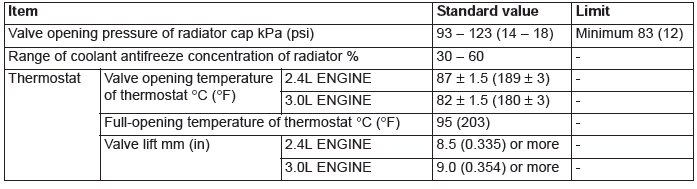
Service Specifications
Coolant

NOTE: *similar high quality ethylene glycol based non-silicate, non-amine, non-nitrate and non-borate coolant with long life hybrid organic acid technology.
Sealant

READ NEXT:
 Engine Cooling Diagnosis
INTRODUCTION
The system cools the engine so that it does not overheat
and maintains the engine at an optimum temperature.
The system components are the radiator,
water pump, thermostat, condenser fa
On-vehicle Service
ENGINE COOLANT LEAK CHECK
WARNING
When pressure testing the cooling system, slowly
release cooling system pressure to avoid getting
burned by hot coolant.
CAUTION
Be sure to completely clean away a
Thermostat
REMOVAL AND INSTALLATION <2.4L ENGINE>
Pre-removal Operation
Engine Coolant Draining
Engine Upper Cover Removal
Air Cleaner Assembly Removal
Post-installation Operation
Air Cleaner Asse
SEE MORE:
Operation under adverse driving conditions
On a flooded road
● Avoid flooded roads. Water could enter the brake discs, resulting in temporarily
ineffective brakes. In such cases, lightly depress the brake pedal to see if the
brakes operate properly. If they do not, lightly depress the pedal several times
while driving in order t
Diagnostic Item 6-13
DIAGNOSTIC ITEM 6: Diagnose when the scan tool cannot receive the data
sent by AWD-ECU
<Electronic controlled AWD>.
CAUTION
When servicing a CAN bus line, ground yourself by touching a metal object such
as an unpainted
water pipe. If you fail to do so, a component connected to the CAN bus li
