
Mitsubishi Outlander: Manual transmission
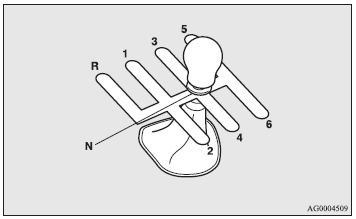
The shift pattern is shown on the gearshift lever knob. Be sure to always fully depress the clutch pedal before attempting to shift the lever.
CAUTION:
● Do not put the gearshift lever into the reverse position while the vehicle is moving forward. Doing so could damage the transmission.
● Do not rest your foot on the clutch pedal while driving.
Doing so could cause rapid wear to the clutch.
NOTE:
● If it is hard to shift into 1st, depress the clutch pedal again;
the shift will then be easier to make.
● To avoid grinding noises when shifting into reverse, wait approximately 3 seconds with the clutch depressed when the vehicle is stationary.
Moving the gearshift lever to the “R” (Reverse) position
CAUTION:
● Do not move the gearshift lever to the gRh (Reverse) position while the vehicle is moving forward; doing so will damage the transmission.
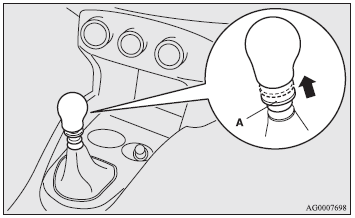
Pull up the pull-ring (A), then move the gearshift lever to the “R” (Reverse) position with the pull-ring still pulled.
CAUTION:
● Do not pull up the pull-ring (A) when moving the gearshift lever to any position other than the “R” (Reverse) position. If you always pulled up the pullring (A) when moving the gearshift lever, you could unintentionally move the gearshift lever to the “R” (Reverse) position and cause an accident and/or a transmission fault.
The pull-ring will return to its original position when you return the gearshift lever to the “N” (Neutral) position.
CAUTION:
● If the pull-ring will not return from the pulled-up position, we recommend you to have the vehicle inspected.
Possible driving speed
Avoid shifting down at high speed, as this may cause excessive engine speed (the tachometer needle into the red zone) and damage the engine.
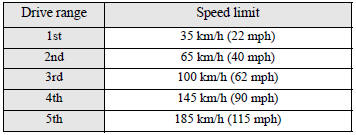
Use 6th gear whenever vehicle speed allows, for maximum fuel economy.
READ NEXT:
 Electronically controlled 4WD system
The electronically controlled 4WD system is an 4-wheel drive system that allows
one of three drive modes to be selected with a switch, in accordance with the driving
conditions.
The following dri
4-wheel drive operation
Your vehicle has been designed primarily for use on pavement.
But its unique 4-wheel drive system allows you to occasionally travel on unpaved
roads, to campgrounds, picnic sites, and similar locat
Inspection and maintenance followingrough road operation
After operating the vehicle in rough road conditions, be sure to perform the
following inspection and maintenance procedures:
● Check that the vehicle has not been damaged by rocks, gravel, e
SEE MORE:
Active stability control (ASC)
The active stability control (ASC) takes overall control of the anti-lock brake
system, traction control function and stability control function to help maintain
the vehicle’s control and traction.
Please read this section in conjunction with the page on the anti-lock brake
system, traction
On-vehicle Service
WINDSHIELD INTERMITTENT WIPER INSPECTION
1. Check that the intermittent wiper interval is
changed as the windshield intermittent wiper volume
is operated.
2. Turn the windshield intermittent wiper switch to
the intermittent operation position. Use the scan
tool to set a simulated vehicle speed with
